What it does
Foam rolling can give a short-term boost in range of motion and may reduce how sore you feel after hard training. It is a useful part of a warm-up or cool-down.
 Next day delivery · Fully tracked · 30-day returns
The Foam Rolling Hub
Every foam rolling guide in one place: how to choose a roller in Ireland, correct technique, what the research really says, and routines by body area and sport.
Quick answer
A quick, honest summary before you dive into the guides: what foam rolling does, what it does not do, and how to use it well.
Foam rolling can give a short-term boost in range of motion and may reduce how sore you feel after hard training. It is a useful part of a warm-up or cool-down.
It does not break up scar tissue, “release” the IT band or flush toxins. Effects are short-term, so think of rolling as part of a routine, not a fix.
Keep pressure comfortable, roll slowly, spend 30–90 seconds per area and pair rolling with movement. Avoid rolling directly on joints, bones or injured areas.
Pre-exercise rolling improves flexibility in the short term without harming performance.
Wiewelhove et al., 2019Post-exercise rolling can modestly reduce perceived soreness.
Systematic review, 2024Built for your routine
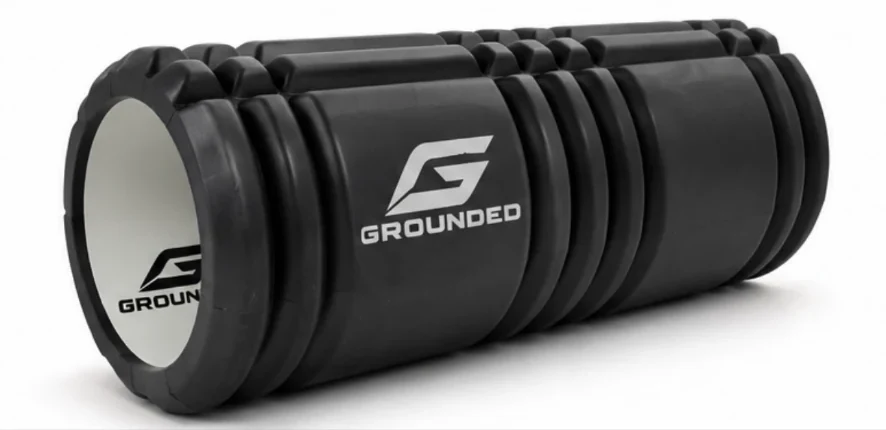
A high-density roller for regular use.
See the Grounded Foam RollerEvidence-led guidance. No inflated claims.
Gaelic footballers, hurlers, soccer and rugby players use a roller in two places: a short, light pass in the warm-up, and a calm session the evening after a match or the next morning. In both, technique matters more than pressure. Research suggests rolling can briefly improve range of motion and may reduce perceived soreness after hard sessions; it does not repair muscle or prevent injury on its own.
A match-day-plus-one routine: calves, quads, hamstrings and glutes for about 60 seconds each side, moving slowly, followed by a walk or easy spin. Keep it comfortable and skip anything bruised from contact. Sleep, food and fluids after the game still do most of the work.
High running volume and Hyrox stations such as sled pushes, lunges and wall balls load the calves, quads and glutes repeatedly. A brief roll before a session can help you feel ready to move; a slower roll afterwards is a comfortable way to wind down.
Keep sessions to 5–10 minutes and spread them across training days rather than one long, hard session. Avoid rolling directly over the IT band or lower back with full body weight, and get persistent pain checked by a physiotherapist.
For most healthy adults, short sessions of 5–10 minutes on training days, or daily if it feels comfortable, are a sensible starting point. Studies reporting benefits usually use around 30–120 seconds per muscle area, so longer or harder sessions are not needed.
Consistency matters more than duration. Skip areas that are bruised, swollen or recently injured, and do not roll through sharp pain. If soreness lasts or keeps returning, get it assessed by a physiotherapist or GP.
What Irish athletes should know before buying a foam roller: types, delivery, returns and where it fits in training.
A decision guide: firmness, texture, size and core matched to your body, sport and experience.
Broad pressure versus targeted pressure — which tool suits which job.
How firmness changes comfort, durability and who each roller suits.
What “high density” means, who benefits from a firm roller and how to check quality.
The benefits research supports, the ones it doesn’t, and how to get the most from each.
Pressure, speed, timing and a simple 8-minute routine you can start today.
Ten essential moves with set-up cues, what to feel and what to avoid.
Nine errors that waste time or cause discomfort, and how to fix each.
Quick answers to the questions we hear most, with links to the in-depth guides.
What systematic reviews show, where the evidence is thin and what that means in practice.
What rolling before training achieves, what rolling after achieves, and how to do both well.
How foam rolling fits into managing delayed onset muscle soreness.
Technique, positioning and where rolling fits alongside hamstring strength.
A supported setup for the front of the thigh, with pressure control, common mistakes and injury cautions.
Rolling both calf muscles, the soleus and the shin — and when calf pain needs a professional.
Why rolling the IT band directly is overrated, and what to do instead.
Figure-four glute rolling, ball work for deeper spots and pairing with activation.
Safe upper-back rolling, why to skip the lower back and when to see a professional.
Tools that make these routines easy to repeat.
How Grounded earns trust
Editorial approach. We link original research, separate findings from practical interpretation and state when evidence is limited.
Athlete safety. Our content is general education, not diagnosis or medical advice. Pain and injury need qualified assessment.
Explore the Grounded knowledge base