

Foam Rolling Hub · Fundamentals
Foam Roller Benefits: What It Can and Can’t Do
The benefits research supports, the ones it doesn’t, and how to get the most from each.
How Grounded earns trust
Evidence explained. Limits made clear.
Editorial approach. We link original research, separate findings from practical interpretation and state when evidence is limited.
Athlete safety. Our content is general education, not diagnosis or medical advice. Pain and injury need qualified assessment.
Quick answer
The short version
- Supported: short-term range of motion gains
- Supported: modest reduction in perceived soreness
- Not supported: “breaking up” fascia, flushing toxins, or preventing injury on its own
Foam rolling is popular because people feel better after it. That feeling is real, but it is worth being precise about what is actually happening and what the evidence supports, so you spend your time well.
Benefits supported by research
- Short-term flexibility: meta-analyses report small improvements in range of motion lasting minutes, useful before training.
- Reduced perceived soreness: rolling after hard exercise is associated with a modest reduction in how sore muscles feel over the next 1–3 days.
- No performance penalty pre-exercise: unlike long static stretching, short rolling bouts do not appear to reduce strength or sprint performance.
- Routine and body awareness: a few minutes on each area helps you notice changes before they become problems worth getting assessed.
Claims to be cautious about
Rolling does not physically break down fascia or scar tissue; the forces involved are too small. It does not flush lactic acid (which clears within an hour anyway) or “detox” muscle. And while it can be part of a sensible warm-up, there is no strong evidence that rolling alone prevents injury.
The likely mechanisms are mainly neural: changes in how the nervous system perceives stretch and pressure, which explains why effects are real but short-lived.
How to make the benefits count
- Before training, roll briefly then move actively — the range gained is a window to use.
- After hard sessions, keep it gentle; soreness relief does not require pain.
- Stay consistent: short, regular sessions beat occasional long ones.
Research referenced
Journal of Bodywork and Movement Therapies · 2024
Preventive effect of foam rolling on muscle soreness after exercise: A systematic review and meta-analysis
Foam rolling after training is a reasonable, low-risk tool to modestly reduce next-day and 2-3 day post-exercise soreness. It is not a cure for soreness and effect sizes are small-to-moderate.
Frontiers in Physiology · 2019
A Meta-Analysis of the Effects of Foam Rolling on Performance and Recovery
Foam rolling can be used as part of a warm-up (does not reduce power/speed, may modestly help) and as a recovery tool post-session; benefits are real but small in magnitude.
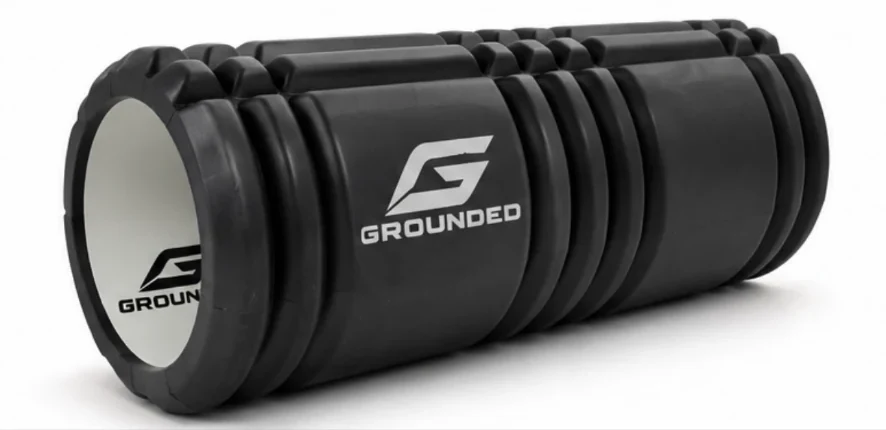
Grounded Foam Roller
High-density, textured and kit-bag sized for regular training.
View the Foam Roller
Grounded Recovery Kit
Foam roller, massage ball, mini bands and long band in one carry bag.
View the Recovery KitQuestions
Does foam rolling break up knots?
No convincing evidence shows it physically removes knots. It changes how tissue feels, likely via the nervous system.
Does foam rolling help recovery?
It can modestly reduce perceived soreness. Sleep, nutrition and load management matter more.
Can foam rolling improve performance?
Effects on sprint or strength are small and inconsistent. Its value is mainly flexibility and feeling ready.
General education only, not medical advice. For pain, injury or a medical condition, see a physiotherapist or doctor.
Related reading across Grounded
Explore the Grounded knowledge base