

Foam Rolling Hub · Fundamentals
Common Foam Rolling Mistakes
Nine errors that waste time or cause discomfort, and how to fix each.
How Grounded earns trust
Evidence explained. Limits made clear.
Editorial approach. We link original research, separate findings from practical interpretation and state when evidence is limited.
Athlete safety. Our content is general education, not diagnosis or medical advice. Pain and injury need qualified assessment.
Quick answer
The short version
- Slower and gentler beats faster and harder
- Avoid joints, bone and the lower back
- Never roll to mask an injury
Most foam rolling mistakes come from treating it as a battle. Slow down, ease off and keep it short.
Mistakes and fixes
- Rolling too fast — slow to 2–3 cm per second.
- Too much pressure — support more weight; you should be able to breathe normally.
- Rolling for too long — 30–90 seconds per area is enough.
- Rolling directly on the lower back — roll glutes and upper back instead.
- Rolling over joints or bone — stay on muscle.
- Hammering the IT band — roll the TFL, glutes and outer quad.
- Holding your breath — slow exhales help you relax.
- Skipping movement afterwards — follow with an active drill.
- Rolling an acute injury — get assessed first.
Posture on the roller
Keep the core lightly braced and shoulders away from the ears, especially in forearm positions. Poor support positions cause neck and wrist strain.
Research referenced
Journal of Bodywork and Movement Therapies · 2024
Preventive effect of foam rolling on muscle soreness after exercise: A systematic review and meta-analysis
Foam rolling after training is a reasonable, low-risk tool to modestly reduce next-day and 2-3 day post-exercise soreness. It is not a cure for soreness and effect sizes are small-to-moderate.
Frontiers in Physiology · 2019
A Meta-Analysis of the Effects of Foam Rolling on Performance and Recovery
Foam rolling can be used as part of a warm-up (does not reduce power/speed, may modestly help) and as a recovery tool post-session; benefits are real but small in magnitude.
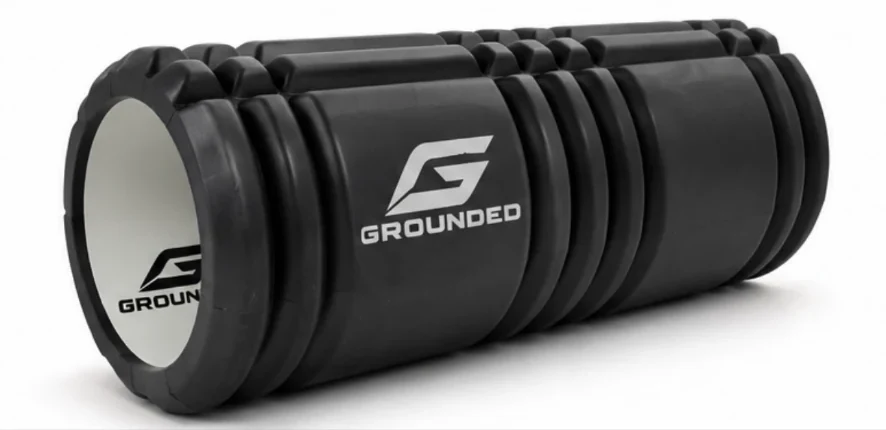
Grounded Foam Roller
High-density, textured and kit-bag sized for regular training.
View the Foam Roller
Grounded Recovery Kit
Foam roller, massage ball, mini bands and long band in one carry bag.
View the Recovery KitQuestions
Can foam rolling make things worse?
Excessive pressure or rolling an injury can aggravate symptoms.
Is it bad to foam roll every day?
No, if it stays brief and comfortable.
General education only, not medical advice. For pain, injury or a medical condition, see a physiotherapist or doctor.
Related reading across Grounded
Explore the Grounded knowledge base