

Foam Rolling Hub · Fundamentals
The Best Foam Roller Exercises for Athletes
Ten essential moves with set-up cues, what to feel and what to avoid.
How Grounded earns trust
Evidence explained. Limits made clear.
Editorial approach. We link original research, separate findings from practical interpretation and state when evidence is limited.
Athlete safety. Our content is general education, not diagnosis or medical advice. Pain and injury need qualified assessment.
Quick answer
The short version
- Choose 3–4 exercises per session
- Follow each with a movement for that area
- Skip anything that causes sharp or nerve-like pain
These ten exercises cover the areas athletes most often want to address. Pick the three or four most relevant to your sport rather than doing all ten every day.
Lower leg
- Calf roll: roller under the calf, hands behind, lift hips; rotate the foot in and out.
- Tibialis (shin muscle): kneel with the roller under the front-outer shin, light pressure only.
Thigh
- Quad roll: face down, roller under thighs, roll hip to just above the knee.
- Adductor roll: face down, one leg out to the side, roller under the inner thigh.
- Hamstring roll: seated, roller under thighs, cross one leg over for more pressure.
- Outer thigh / TFL: side-lying at the front of the hip; avoid rolling directly on the knee side.
Hips and back
- Glute roll: sit on the roller, cross one ankle over the opposite knee, lean into that side.
- Hip flexor: face down, roller just below the hip bone, small movements.
- Upper back: roller across the shoulder blades, hands supporting the head, gentle extension.
- Lats: side-lying, arm overhead, roller under the armpit area.
Common errors
- Rolling too fast
- Rolling the lower back directly
- Holding the breath
- Rolling on bone or joints
Research referenced
Journal of Bodywork and Movement Therapies · 2024
Preventive effect of foam rolling on muscle soreness after exercise: A systematic review and meta-analysis
Foam rolling after training is a reasonable, low-risk tool to modestly reduce next-day and 2-3 day post-exercise soreness. It is not a cure for soreness and effect sizes are small-to-moderate.
Frontiers in Physiology · 2019
A Meta-Analysis of the Effects of Foam Rolling on Performance and Recovery
Foam rolling can be used as part of a warm-up (does not reduce power/speed, may modestly help) and as a recovery tool post-session; benefits are real but small in magnitude.
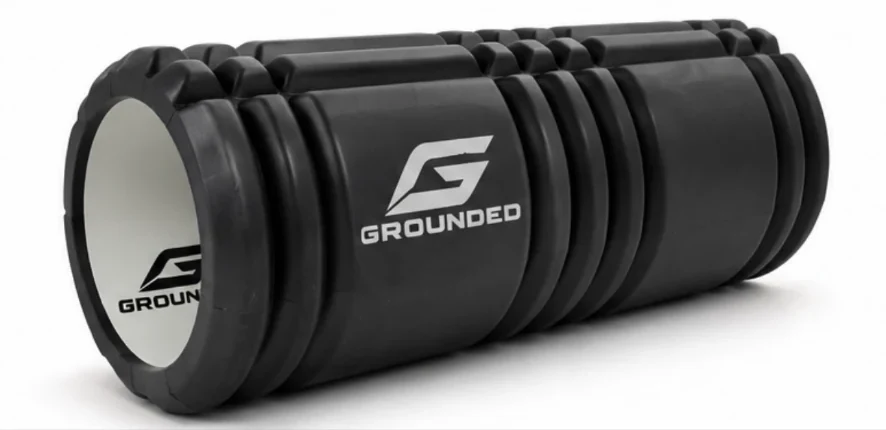
Grounded Foam Roller
High-density, textured and kit-bag sized for regular training.
View the Foam Roller
Grounded Recovery Kit
Foam roller, massage ball, mini bands and long band in one carry bag.
View the Recovery KitQuestions
What are the most important foam roller exercises?
For field-sport athletes: calves, quads, glutes and upper back cover most needs.
How many foam roller exercises should I do?
Three or four per session is enough for most athletes.
General education only, not medical advice. For pain, injury or a medical condition, see a physiotherapist or doctor.
Related reading across Grounded
Explore the Grounded knowledge base