

Foam Rolling Hub · Body area
Foam Rolling for Hamstrings
Technique, positioning and where rolling fits alongside hamstring strength.
How Grounded earns trust
Evidence explained. Limits made clear.
Editorial approach. We link original research, separate findings from practical interpretation and state when evidence is limited.
Athlete safety. Our content is general education, not diagnosis or medical advice. Pain and injury need qualified assessment.
Quick answer
The short version
- Seated position, cross one leg to add pressure
- Turn the leg in and out to cover the inner and outer hamstrings
- Strength work (e.g. Nordics) is the main protective factor
Hamstrings take a heavy load in sprinting sports. Rolling can make them feel looser before training, but tightness is not the same as injury risk.
Technique
- Sit with the roller under the thighs, hands behind you
- Lift hips and roll from just below the glute to above the knee
- Cross one leg over the other for more pressure
- Rotate the leg to reach inner and outer sections
What rolling can and can’t do
It can provide short-term improvements in hamstring flexibility. It does not replace progressive strength and sprint exposure, which have the strongest evidence for reducing hamstring injury. Sudden pain while sprinting needs assessment, not rolling.
Should you foam roll a pulled hamstring?
Do not roll a suspected hamstring strain, especially after sudden pain, swelling or bruising. A pulled hamstring is an injury, not simply a tight muscle, and deep pressure is not a way to repair it. Stop the activity and seek assessment if you suspect a strain.
After an injury, let your clinician guide when to resume exercise and whether rolling has any place in your rehabilitation. Do not use reduced soreness after rolling as proof that you are ready to sprint or play.
Research referenced
Frontiers in Physiology · 2019
A Meta-Analysis of the Effects of Foam Rolling on Performance and Recovery
Foam rolling can be used as part of a warm-up (does not reduce power/speed, may modestly help) and as a recovery tool post-session; benefits are real but small in magnitude.
British Journal of Sports Medicine · 2019
Including the Nordic hamstring exercise in injury prevention programmes halves the rate of hamstring injuries: a systematic review and meta-analysis of 8459 athletes
Adding Nordic hamstring curls to a team's strength/prevention program roughly halves hamstring injury rates — one of the strongest single-exercise injury-prevention effects in sports science, directly relevant to GAA, soccer, and rugby.
External references
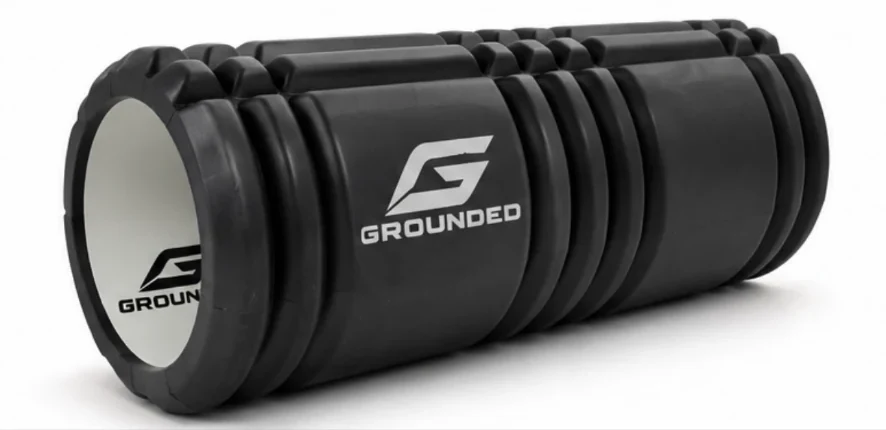
Grounded Foam Roller
High-density, textured and kit-bag sized for regular training.
View the Foam Roller
Grounded Recovery Kit
Foam roller, massage ball, mini bands and long band in one carry bag.
View the Recovery KitQuestions
Can foam rolling prevent hamstring injuries?
There is no strong evidence it does alone. Strength programmes such as Nordic curls have much stronger support.
Should I roll a pulled hamstring?
Not in the acute phase. Get assessed first.
General education only, not medical advice. For pain, injury or a medical condition, see a physiotherapist or doctor.
Related reading across Grounded
Explore the Grounded knowledge base