

GAA Recovery Hub · Core guides
The Ultimate GAA Recovery Guide
Everything a GAA player needs to recover well, in order of importance.
How Grounded earns trust
Evidence explained. Limits made clear.
Editorial approach. We link original research, separate findings from practical interpretation and state when evidence is limited.
Athlete safety. Our content is general education, not diagnosis or medical advice. Pain and injury need qualified assessment.
Quick answer
The short version
- 1. Sleep 2. Nutrition 3. Hydration 4. Load management 5. Mobility and tools
- Tools support the basics; they don’t replace them
- Recurring pain needs a physio, not more gadgets
Gaelic games demand repeated sprints, contact, and often multiple teams across club, college and county. Recovery isn’t optional — it is where training becomes improvement.
This guide sets out the priorities in order. The rest of the GAA Recovery Hub goes deeper on each.
The five pillars for GAA players
- Sleep: 7–9 hours, consistent timing
- Nutrition: carbohydrate and protein after sessions
- Hydration: rehydrate with fluid and sodium
- Load: communicate across teams to avoid overload
- Mobility and tools: short, repeatable routines
Injury context
Studies of Gaelic football report hamstring, knee and ankle injuries among the most common. Strength work, structured warm-ups and sensible load management are the evidence-based priorities.
What a GAA match does to the body
Gaelic football and hurling combine repeated sprints, sudden decelerations, jumping, contact and long periods of moderate running. That mix causes muscle damage — mainly in the hamstrings, quads, calves and adductors — along with depleted energy stores and fluid loss.
Most players feel the effects for one to three days. How long depends on minutes played, contact, the pitch, and how well you slept and ate in the days around the game.
The first 72 hours after a match
Recovery happens in stages. Keep it simple and in this order.
0–2 hours
Cool down with easy jogging or walking. Start rehydrating, and eat a meal or substantial snack containing carbohydrate and protein. A hot shower and dry clothes matter more than they sound on a cold evening.
Match night
Sleep is the most powerful recovery tool available. Limit late caffeine and screens where possible; adrenaline can make sleep harder after evening games.
24 hours
Light movement — a walk, swim or easy cycle — plus gentle rolling and mobility usually feels better than complete rest. Keep eating well.
48–72 hours
Most players are ready for normal training. Soreness that is worsening, sharp or localised to one spot should be assessed.
Managing load across club, college and county
Irish players are unusual in how many teams they can play for at once. Overload often comes from the total, not from any single team’s plan. Keep a simple log of sessions and matches, and share it with coaches when teams overlap.
During championship, with games close together, prioritise sleep, food and lighter sessions between matches rather than adding extra work.
Nutrition and hydration for GAA players
After a match or hard session, aim for a meal that combines carbohydrate (pasta, rice, potatoes, bread) to refill energy stores with protein (meat, fish, eggs, dairy) to support muscle repair. Research in our library supports daily protein intake around 1.6 g per kg of body weight for people training for strength and muscle; spreading it across meals is practical.
- Rehydrate gradually over several hours rather than all at once.
- Add sodium — from food or electrolytes — after heavy sweating or hot days.
- Do not rely on supplements to fix an inconsistent diet.
Injury prevention: what the evidence supports
Studies of Gaelic football in our Research Library consistently report hamstring, knee and ankle injuries among the most common. The best-supported prevention measures in field sports are structured warm-ups and strength work. A meta-analysis on the Nordic hamstring exercise found programmes including it roughly halved hamstring injury rates.
Recovery tools have a supporting role: making warm-ups and mobility easier to do consistently. They do not replace strength training or a physio.
Recovery tools that suit GAA players
Keep equipment simple and portable so it actually comes to training.
Common GAA recovery mistakes
These come up again and again at club level.
- Skipping food after an evening match and going to bed hungry.
- Treating the post-match night out as recovery.
- Training hard the day after a game to “flush it out”.
- Playing through recurring hamstring or groin tightness.
- Saying yes to every team without telling coaches about the total load.
Sleep for GAA players
The 2021 expert consensus on sleep in athletes, linked on this page, recommends prioritising sleep quantity and regularity. Aim for 7–9 hours with consistent timing, a cool dark room, and a wind-down routine after late matches. A short early-afternoon nap can help after a poor night.
Independence note
Grounded Recovery is an independent Irish brand and is not affiliated with or endorsed by the GAA.
Recovery for hurlers and camogie players
Hurling and camogie add repeated twisting, swinging and overhead work to the running demands of Gaelic games. Alongside lower-body recovery, players often benefit from upper-back and hip mobility, and from keeping wrists and forearms supple during heavy training blocks. A long resistance band and a massage ball cover most of this in a few minutes.
Expert tips from the dressing room
Small habits add up across a season.
- Pack a recovery snack and a bottle in the gear bag so refuelling starts before the drive home.
- Change out of wet gear quickly after cold, wet games.
- Note how you feel each morning on a simple 1–10 scale; a run of low scores is a signal to ease off.
- Keep a band warm-up you can do anywhere, so pitch-side delays do not leave you cold.
- Tell your coach early about niggles rather than after they become injuries.
Research referenced
British Journal of Sports Medicine · 2018
A systematic review, meta-analysis and meta-regression of the effect of protein supplementation on resistance training-induced gains in muscle mass and strength in healthy adults
During a structured strength program, hitting roughly 1.6 g/kg/day total protein (spread across meals) supports meaningfully greater strength and lean mass gains than training alone; intakes beyond this show diminishing average benefit.
British Journal of Sports Medicine · 2019
Including the Nordic hamstring exercise in injury prevention programmes halves the rate of hamstring injuries: a systematic review and meta-analysis of 8459 athletes
Adding Nordic hamstring curls to a team's strength/prevention program roughly halves hamstring injury rates — one of the strongest single-exercise injury-prevention effects in sports science, directly relevant to GAA, soccer, and rugby.
Journal of Science and Medicine in Sport · 2021
Epidemiology and moderators of injury in Gaelic football: A systematic review and meta-analysis
For GAA-specific recovery/prevention programming, hamstring and other lower-limb muscle injuries should be the top priority, and match-day preparation (warm-up, hamstring strength work) deserves more attention than training-day load alone.
The American Journal of Sports Medicine · 2012
Incidence of Injury in Gaelic Football: A 4-Year Prospective Study
Match play carries roughly 15x the injury rate of training in elite Gaelic football, and hamstrings are by far the single biggest injury target — supports prioritizing hamstring-specific prevention (e.g., Nordic curls) and second-half conditioning/fatigue management.
External references

Grounded Recovery Kit
Foam roller, massage ball, mini bands and long band in one carry bag.
View the Recovery Kit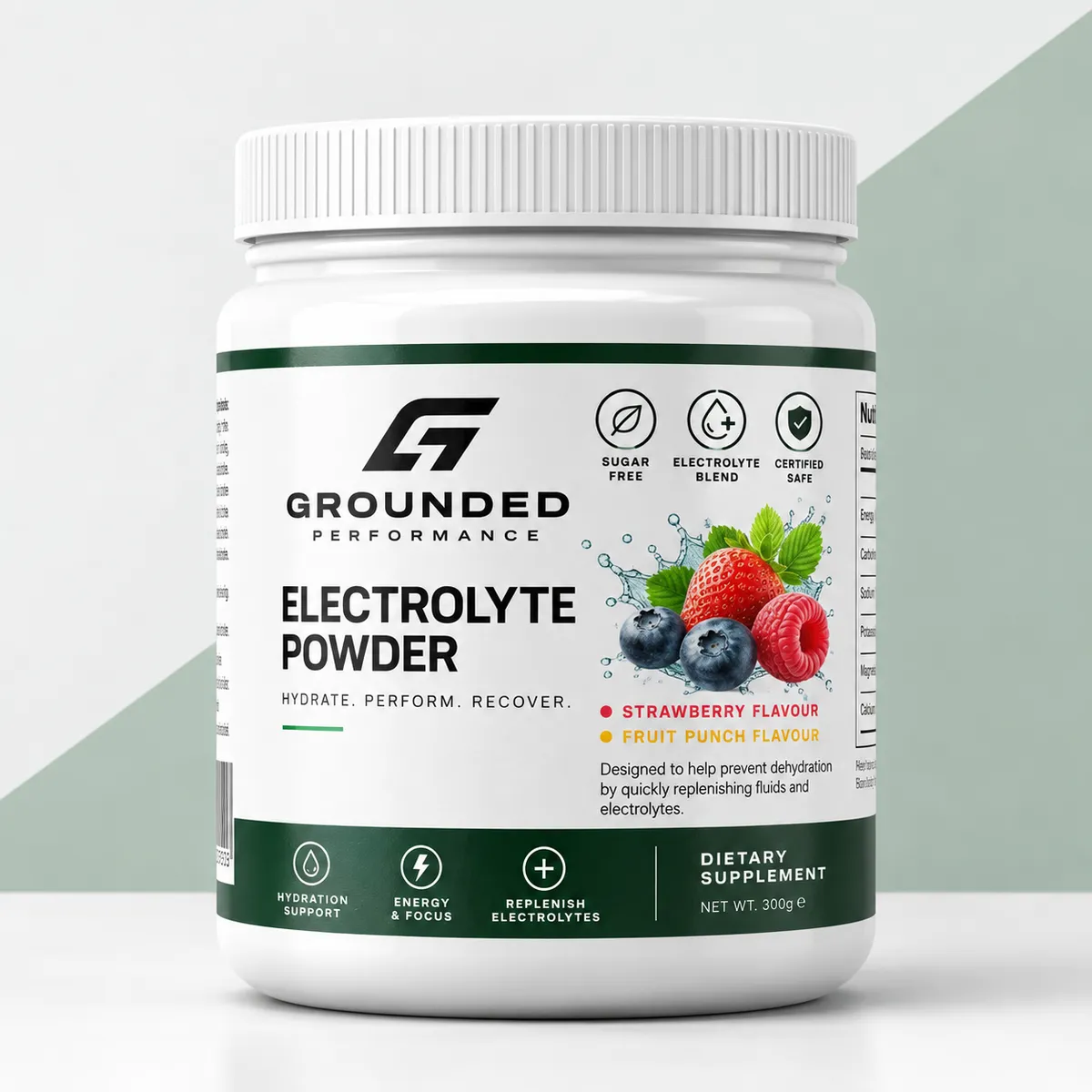
Grounded Electrolytes
Launching soon. Join the waiting list to hear first.
Join the waiting listQuestions
What is the best recovery for GAA players?
Sleep, food and fluids first, then light movement and mobility.
How long does it take to recover from a GAA match?
Most players feel recovered within 48–72 hours; it depends on minutes played and contact.
Should I train the day after a GAA match?
Light active recovery, such as walking, swimming or easy cycling, usually helps more than hard training or total rest.
Are ice baths good for GAA recovery?
They can reduce soreness short term, but regular use straight after strength sessions may blunt strength gains. Use them selectively, such as between close championship games.
What should a GAA player eat after a match?
A meal with carbohydrate and protein within a couple of hours, plus fluids. For example, chicken and rice, a pasta dish, or eggs on toast with milk.
How do county players recover between games?
Usually with consistent sleep, structured nutrition, lighter sessions between matches and support from medical staff. The principles apply at every level.
Grounded is independent and not affiliated with the GAA. General education only, not medical advice. For pain, injury or a medical condition, see a physiotherapist or doctor.
Related reading across Grounded
Explore the Grounded knowledge base