

Grip Socks Hub · Buying
Grip Socks in Ireland: What to Know Before You Buy
The practical guide to buying grip socks in Ireland: fit, materials, delivery and how they are worn.
How Grounded earns trust
Evidence explained. Limits made clear.
Editorial approach. We link original research, separate findings from practical interpretation and state when evidence is limited.
Athlete safety. Our content is general education, not diagnosis or medical advice. Pain and injury need qualified assessment.
Quick answer
The short version
- Grip pads on heel and forefoot matter most
- Fit should be snug with no bunching
- Worn under cut team socks, so club colours stay visible
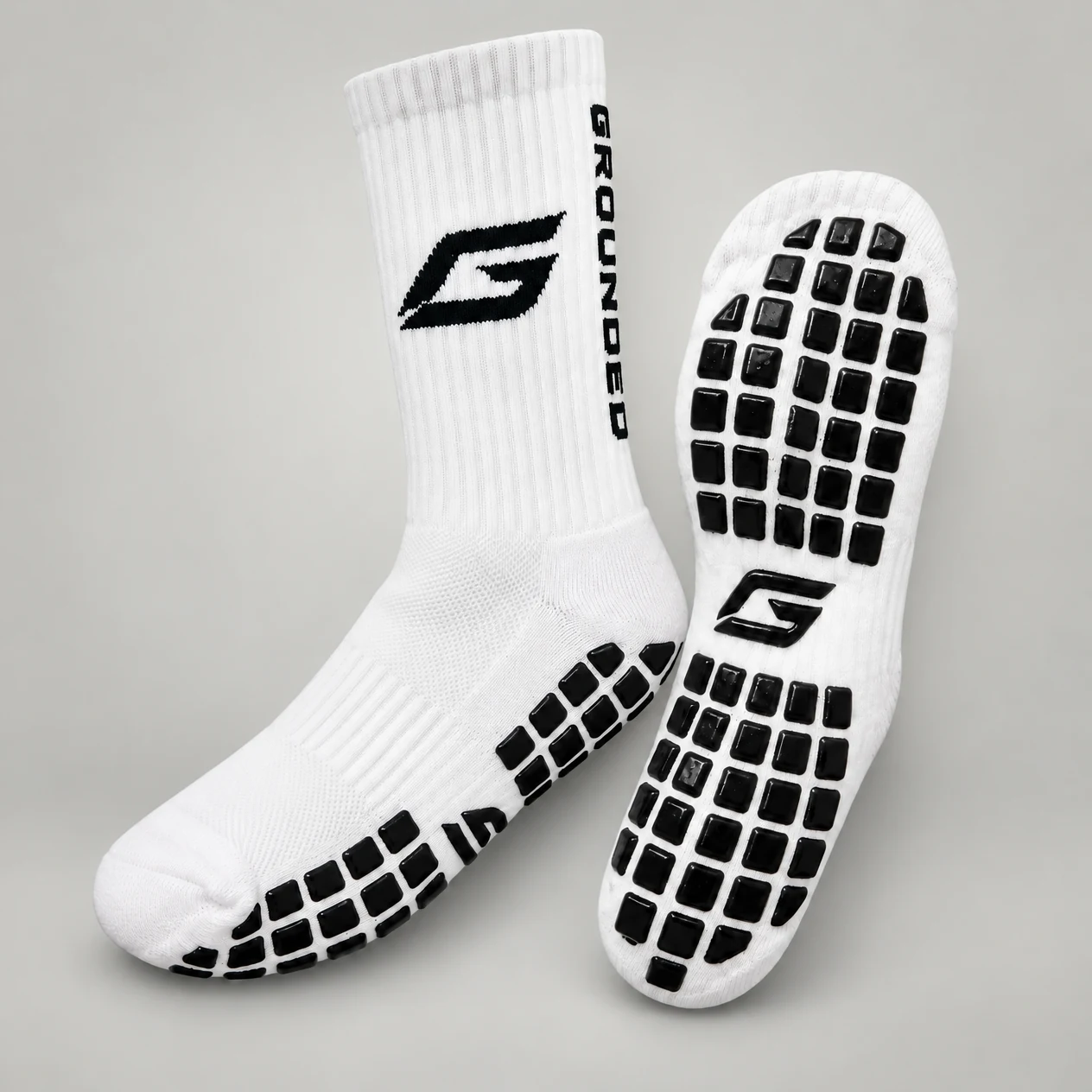
Grip socks have gone from a professional-dressing-room secret to a standard sight on Irish pitches every weekend. They are a short sock with rubberised pads on the sole, worn under cut team socks, designed to reduce how much the foot slides inside the boot.
This guide covers fit, care and buying considerations in Ireland. Browse our Grip Socks Ireland collection for Grounded product photos and launch availability. For choosing between pairs, see how to choose grip socks; for sport-specific advice, see the GAA, football and rugby pages in the Grip Socks Hub.
Why grip socks took off in Irish sport
Irish pitches are often wet, and a slipping foot in a damp boot is a familiar frustration. Grip socks became popular when players saw professionals cutting holes in match socks and wearing a grip sock underneath. Club, school and county players have followed.
What to look for
- Pad coverage on the heel and forefoot, not just a few dots
- Breathable, cushioned knit that dries reasonably quickly
- A size range that fits snugly without folds
- Durability after repeated 30°C washes
Grounded grip socks: photos, availability and ordering
Grounded Grip Socks are launching soon. Our collection links to the supplied product photos and launch list; confirmed sizes, price and full specifications will be available before ordering. Read the current delivery and returns policies rather than assuming a delivery date or return entitlement from this guide.
How grip socks work
Inside a boot, a normal sock can move against the insole when you plant, cut or accelerate. Grip socks add rubberised pads on the sole that increase friction between foot, sock and insole, so the foot stays more settled in the boot.
Most players describe the benefit as feeling more connected to the boot, especially in wet conditions. That feeling is real for many people, but it is worth being clear that controlled research on grip socks is still limited.
Grip socks vs regular and compression socks
These three sock types do different jobs, and many players wear a grip sock under a cut team sock.
How to choose grip socks
The best pair is the one that fits well and survives the wash. Look at these details before buying.
Pad layout
Pads on the heel and under the forefoot matter most, because that is where slipping happens during acceleration and braking. A handful of small dots across the sole does less.
Fit and size
A grip sock should feel snug from toe to ankle with no folds. Too large and the fabric bunches; too small and it pulls the toes. If you are between sizes, consider how tight your boots already fit.
Fabric and cushioning
A breathable knit with light cushioning under the foot is comfortable for 70-minute matches and dries more quickly between sessions.
Durability
Check that pads are bonded well. Cheaper pairs can lose grip after a handful of washes.
How to wear grip socks with team socks
The usual set-up is a grip sock on the foot, then a team sock with the foot cut off (or a footless sleeve) over the shin guard. Pull the grip sock on first, smooth out any folds, then the team sock, then tape if you use it. Check your competition’s rules on sock colour and visible layers.
Common grip sock mistakes
Small details make a big difference to how grip socks feel.
- Choosing a size that bunches under the arch.
- Washing hot or tumble drying, which can weaken pads.
- Wearing a worn insole that moves regardless of the sock.
- Expecting grip socks to fix a boot that is the wrong size.
- Trying a new pair for the first time on match day.
What the evidence says about grip socks
There is limited peer-reviewed research on grip socks specifically. The case for them rests mainly on the simple idea that less movement inside the boot feels more secure, and on widespread use at the elite level. We would rather say that plainly than overstate it.
For injury prevention, the strongest evidence in team sport supports structured warm-ups such as the FIFA 11+ programme and hamstring strength work. Grip socks are a comfort and confidence item, not an injury-prevention programme.
Washing and care
Follow the care label for your pair. Cool washing and air drying are common general recommendations, not a confirmed Grounded care specification. Check the current delivery and returns policies before ordering.
Grip socks by sport
The basic idea is the same across sports, but players use grip socks a little differently.
Gaelic football and hurling
Constant direction changes on heavy pitches make foot security a common request. Most players wear grip socks under cut county or club socks, keeping the team colours visible from the shin up.
Soccer
Grip socks are now routine in many senior and underage dressing rooms. Players with looser-fitting boots, or boots that have stretched with age, often notice the difference most.
Rugby
Forwards in scrums and rucks, and backs accelerating off the mark, both value a foot that stays put. Fit matters, as rugby boots are often worn with tape around the ankle.
Gym and indoor training
On smooth gym floors or in training shoes, grip socks can add security during lunges, sled work and agility drills.
Expert tips for first-time wearers
Wear new grip socks for two or three training sessions before a match, so you know how they feel with your boots and tape. If your boots were sized with thick socks in mind, a thinner grip sock may leave a little extra room; lacing more firmly across the midfoot usually solves that. Bring a spare pair in the gear bag for wet days when a soaked sock loses comfort.
Research referenced
Grounded Grip Socks
Launching soon. Join the waiting list to hear first.
Join the waiting list
Grounded Recovery Kit
Foam roller, massage ball, mini bands and long band in one carry bag.
View the Recovery KitQuestions
Where can I buy grip socks in Ireland?
Sports retailers and online stores stock them. Grounded Grip Socks are launching soon with tracked Irish delivery.
Are grip socks allowed in Irish sport?
They are widely worn, but always check your competition and club kit rules, particularly for sock colour.
Do grip socks come in sizes?
Most come in two or three sizes. A snug fit is important for grip.
Are grip socks worth it?
Many players find they feel more secure in the boot, especially in wet conditions. Research is limited, so treat them as a comfort item rather than a performance guarantee.
Do professional players wear grip socks?
Many do, usually under cut team socks. That is common practice, not proof of a performance effect.
How long do grip socks last?
With cool washing and air drying, a good pair should last a season of regular use. Replace them when the pads wear smooth.
Can I wear grip socks for training and the gym?
Yes. They suit any sport in boots or trainers where the foot tends to slide.
General guidance only. Grounded is independent and not affiliated with the GAA, FAI, IRFU or any county board. Check your competition’s kit rules.
Related reading across Grounded
Explore the Grounded knowledge base